Bring a material sample to the conversation.
GUIDANCE FROM FIRST SAMPLE TO HANDOFF

OMTech Laser Setup Services Built Around Your Actual Job

Machine selection becomes clearer when the conversation starts with material, part geometry, finish, volume, utilities, and operator experience. Our guided path turns those details into testable setup decisions.

See the guidance paths ↓
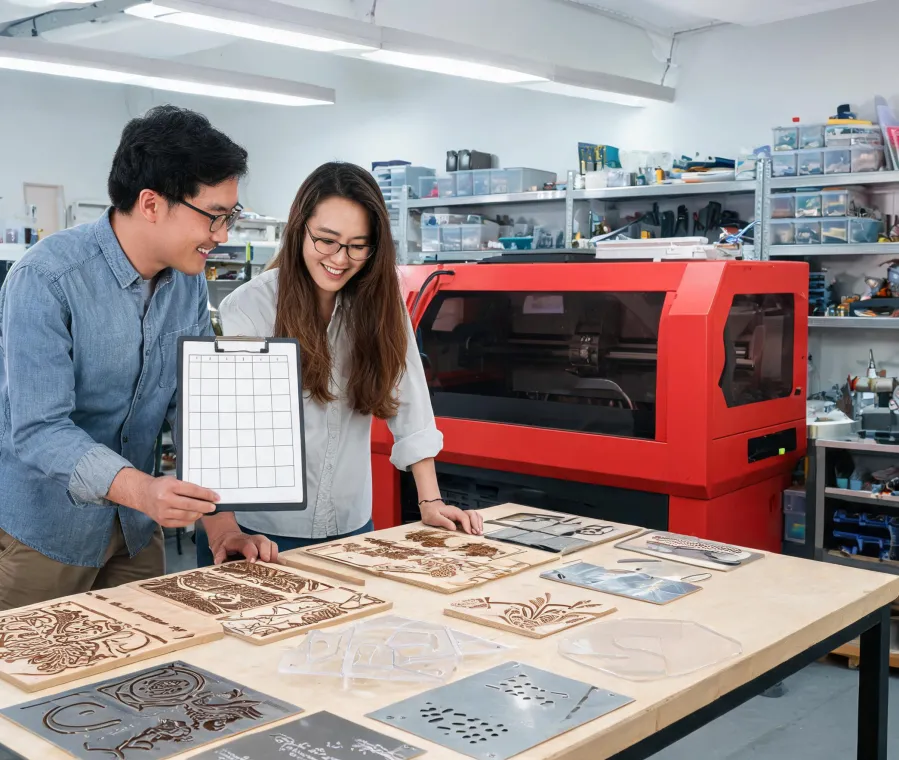
Laser application advisor reviewing test samples with a workshop operator
TWO PRACTICAL PATHS

Choose the Help That Matches Your Decision

A

Material and Process Fit

Use this path when the main question is whether CO2, fiber marking, or laser welding fits the job. Record substrate, thickness, coating, part size, target edge or mark, and the planned inspection method. A useful trial compares at least three settings while holding focus, lens, and material batch constant.

  • Source family and wavelength discussion
  • Working-area and fixture review
  • Sample matrix planning
  • Visible limitations documented before purchase
B

Installation and Workflow Readiness

Use this path after the process family is known. Map machine access, electrical service, cooling, compressed air or shielding gas, exhaust, filtration, fire controls, computer location, and operator handoff. The output is a practical readiness list, not a substitute for local code review or a site-specific safety assessment.

  • Utility and floor-space checklist
  • Ventilation route discussion
  • Operator startup sequence
  • Maintenance access and cleaning rhythm
DECISION NOTES

Advice With the Trade-offs Left In

A trustworthy recommendation includes what the machine will not do well. The answers below explain common boundaries before a sample reaches the bed.

A standard CO2 source is usually chosen for organic materials and coated or treated surfaces. Direct durable marking on many bare metals is a fiber-laser task. Some marking compounds can create a surface result, but adhesion, contrast, processing time, and consumable cost should be tested on the exact alloy.

Start with enclosure volume, duct length, bends, filter resistance, make-up air, and the fumes produced by approved materials. A short straight discharge path behaves differently from a long filtered run. Verify airflow at the machine after installation rather than relying only on a fan nameplate.

Label the material supplier and batch, thickness, machine family, rated source power, lens, focal position, speed, power setting, pulse or frequency setting where applicable, assist condition, and observed result. Keep the physical sample with the dated record.
FROM HUNCH TO TEST PLAN

What Changes After a Guided Review

Before the review

  • “I need the highest wattage in budget.”
  • The largest advertised bed is assumed to be usable.
  • Ventilation is postponed until delivery.
  • A web settings chart is treated as a finished recipe.

After the review

  • Source family follows substrate and desired result.
  • Part, fixture, travel, and loading clearance are measured.
  • Extraction, cooling, utilities, and access are mapped.
  • A labeled test matrix becomes the starting procedure.
START WITH SIX FACTS

Give an OMTech Advisor Enough Detail to Be Useful

Send the material, thickness, largest part, target result, expected daily quantity, and available utilities. If any item is unknown, say so; uncertainty is useful when it is visible.

  • No invented production claim is required
  • Samples and photos can be referenced in follow-up
  • Final settings remain subject to controlled validation
Please tell us who we are helping.
Enter a valid email address.
A short project description helps us route your request.